Scaling a company? Preserving institutional knowledge? Trying to understand a new role? The DACUM process—Developing A Curriculum—is purpose-built to help. In April Executive Director Jill Thornton traveled to the home of DACUM at The Ohio State University to learn facilitation techniques, the uses of DACUM and how to put all the information that makes up a job into a single, concise and compelling document.
Imagine a skilled Tool & Die Maker, decades into the job, finally deciding to retire. Will they take everything they know with them? It’s not in any manual. Nobody quite captured it. This is one of the most persistent and expensive problems in the trades and manufacturing.
Now imagine a small manufacturer taking on a new project and tasking superstar employees to take on more and more. They realize this isn’t sustainable, the job needs to be broken out into two, but how to go about that? This is a good problem to have, but small manufacturers may not have the time or the expertise to define the new role clearly.
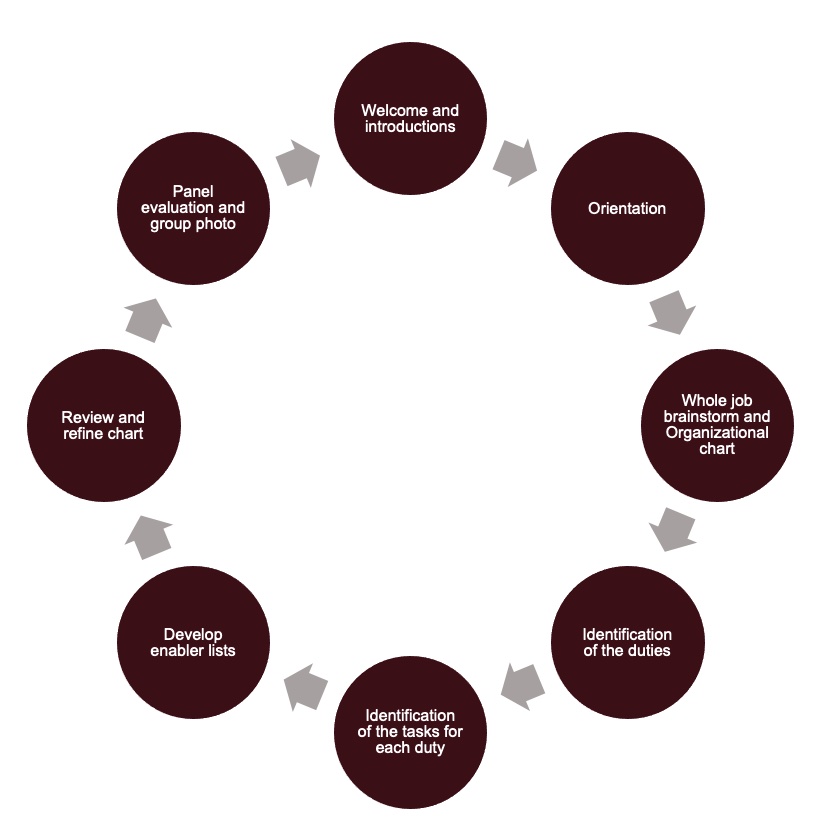
DACUM is a response to both of these problems, a tool that brings subject matter experts into the room with a trained facilitator to describe a job in the detail needed to define that job. Creating duty and tasks statements, identifying skills and knowledge, spelling out acronyms and considering future trends are all parts of a quality DACUM chart.
“I didn’t really know what to expect,” said COE Executive Director Jill Thornton, reflecting on the experience. “But on day one we started our FAKUM, a fake DACUM, where we pretended to be servers at a restaurant, with a script. Then on Wednesday and Thursday we did a real DACUM with a company. We’d completed a little bit of e-learning before we got there, but they just threw us to the wolves, and it was a really good learning experience.” Review that DACUM chart here.
Throughout the week’s training, Thornton found that, “a good DACUM facilitator is able to listen and ask probing questions, allowing the subject matter experts to come up with things on their own, but also ask those probing questions when they are struggling to identify a word or a concept.”
Thornton believes that DACUMs can play a needed role in aerospace and advanced manufacturing. “If you have an individual at a company who has a ton of history and expertise in that role, and they’re getting ready to retire or leave that position, you don’t want to lose all that institutional knowledge. There’s a way to use DACUM to extract that knowledge, so that when they retire or leave the company, all that information is not going with them. In smaller welding, manufacturing, and maritime shops, sometimes they only have one person doing a set of tasks.” DACUM can solve the problem of that lost knowledge.
Thornton also highlights that DACUMs are a great way to assist with curriculum development. “The amount of skills and duties required for one person has expanded immensely. You’re doing 12 different jobs all in one, especially now with industry changing with AI. College can use DACUMs to make sure the curriculum they’re teaching is aligning with the trends in industry.” The Center of Excellence has a history with DACUM, having hosted an Avionics Technician DACUM in 2022. Review that DACUM chart here.